Football
IPTV for Marketers and Brand Builders: How Live Sports Streaming Is Rewriting the Playbook in the USA
If you work in marketing, advertising, or brand strategy, you already know one truth: audiences don't gather around billboards anymore — they gather around live moments. And no live moment commands attention like sport. Whether it's a Sunday NFL slate, a Champions League night, or a UFC main card, live sports streaming is where attention, emotion, and ad spend converge.
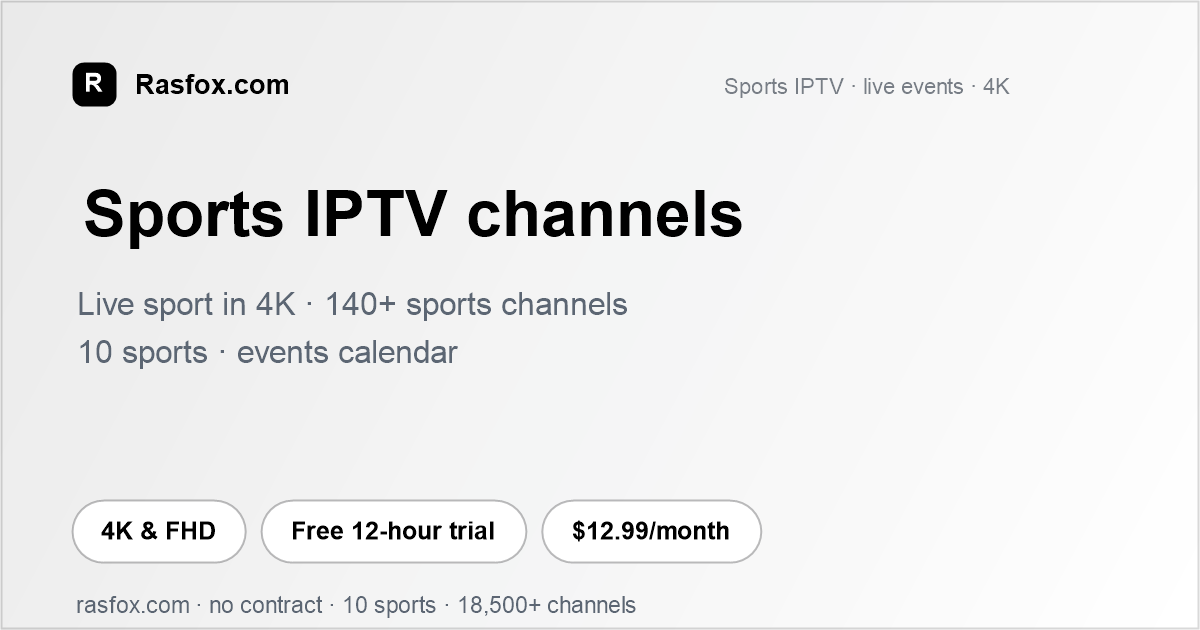
That's exactly why more marketers, agency owners, and small business advertisers in the United States are turning to IPTV — not just as a cheaper cable replacement, but as a real business tool. It gives you the live sports you need for client research, hospitality displays, content creation, and competitive analysis, all for a fraction of what a traditional cable package costs.
In this guide, we'll break down what IPTV actually is, why it matters for the marketing niche, how the US streaming landscape looks right now, and how the best IPTV service can become part of your agency's toolkit.
What Is IPTV and Why Does It Matter to Marketers?
IPTV stands for Internet Protocol Television. Instead of routing channels through a coaxial cable, satellite dish, or fiber bundle, IPTV delivers live TV and on-demand content over your regular internet connection. If you can stream Netflix, you can stream IPTV.
For the average viewer, that means lower bills and more channels. For a marketer, it means something bigger: unrestricted access to the exact live environments where your audience spends its attention.
Here's the practical breakdown of why IPTV has become a serious consideration for agencies and content teams:
- Real-time audience research. You can't advise a sports-adjacent brand if you've never watched the broadcast. IPTV puts you in the room — literally — with the ad breaks, the sponsorships, the halftime integrations, and the on-screen graphics.
- Zero contract lock-in. No 24-month cable agreements. You scale up during football season and scale down when it ends.
- Cost efficiency. Cable packages with premium sports tiers routinely run $100–$200+ per month in the US. IPTV providers operate at a fraction of that.
- Multi-screen flexibility. Need one screen for the game and one for your dashboard? Two simultaneous connections make that easy.
- 4K quality. Modern IPTV streams in 4K at 50FPS — smooth motion, no blur on fast breaks, and broadcast-grade clarity.
In short: IPTV is not a gimmick. It's infrastructure. And for marketers, infrastructure is leverage.
The Thematic Bridge: How IPTV Upgrades Your Marketing Playbook
Here's the natural intersection between marketing and IPTV: both industries are in the business of capturing attention at the exact moment it peaks. Live sports is the last true appointment-viewing format left. If you want to understand attention in 2025, you have to watch where it goes live.
1. Hospitality and Local Business Clients
If your agency manages marketing for restaurants, bars, barbershops, gyms, or sports cafés, you already know the problem: those clients live and die by what's on their screens. A sports bar with a dead TV is a sports bar with empty tables.
IPTV solves that pain point directly. One subscription, 12,000+ channels, and the ability to show multiple games across multiple screens — without paying for five separate cable boxes. For agencies offering value-added services, IPTV for restaurants and sports bars is a genuinely useful upsell that keeps your client's venue full and your retainer sticky.
2. Content Creation and Social Strategy
Sports content dominates social feeds. Highlights, reaction clips, breakdown threads, live-tweeting during a big match — all of it requires you to actually be watching the match. A lagging or unreliable stream means you're publishing your reaction five minutes after the moment has passed.
A buffer-free IPTV connection means you see it live, and you publish while the conversation is still hot. That's the difference between a post that trends and a post that gets buried. If your content calendar revolves around live events, learning to stream live sports in 4K without buffering is a professional advantage, not a luxury.
3. Competitive and Creative Intelligence
Advertisers spend enormous budgets on live sports placements. As a marketer, studying those placements — the sponsor bumpers, the stadium branding, the creative used by brands like the ones you represent — is free market research. IPTV gives you access to those broadcasts from the US, Europe, and Latin America without needing a subscription in each territory.
4. Client Entertainment and Pitches
Few things close a deal like a shared live moment. Having the Premier League match on in the background during a pitch meeting isn't unprofessional — it's rapport building. And in an industry where relationships matter as much as decks, that's worth something.
Deep Dive: The IPTV Landscape in the United States
The US streaming market is the most fragmented in the world. Between cable, satellite, and a dozen competing streaming apps, consumers are exhausted — a phenomenon analysts call subscription fatigue. The average American household now pays for four or more streaming services and still can't watch every game they want.
That fragmentation is the opening. IPTV consolidates it.
For US audiences, the sports lineup typically includes:
- ESPN and ESPN+ — the backbone of American sports broadcasting
- Fox Sports and FS1 — NFL, MLB, and college sports
- CBS Sports and NBC Sports — Sunday football, golf, and the Olympics
- TNT Sports — NBA and NHL coverage
- DAZN, beIN Sports, and Sky Sports — for international football and boxing
- Eurosport — cycling, tennis, and winter sports
Popular competitions for US viewers span every timezone: the NFL, NBA, MLB, NHL, Premier League, the Champions League, La Liga, UFC, Formula 1, and the fast-growing Liga MX fanbase across the Southwest.
Built Sports-First, By Sports People
There's a reason RasFox.com treats sport as the core of its product rather than an add-on. Its roots trace back to Radio Malena 89.1 FM at Venezuela 370 in Buenos Aires — a station steeped in tango, Argentine culture, and the country's deep, almost religious relationship with football. That broadcast heritage is now channeled into IPTV built for Portuguese- and Spanish-speaking communities worldwide, and extended to English-speaking markets across North America.
What that heritage produces is a service that understands one thing deeply: you do not want the stream to fail during a penalty shootout.
The standard RasFox package includes:
- 12,000+ live channels spanning sports, news, entertainment, and kids' content
- 40,000+ VOD titles in on-demand libraries
- 4K at 50FPS for sharp, lag-free motion
- 2 simultaneous screens — ideal for work and play at once
- No buffering on stable connections
- No contract — month-to-month flexibility
- 24-hour free trial so you can stress-test it during a live match
- Portuguese- and Spanish-speaking support for bilingual agencies and Latino-market teams
For an agency that bills by the hour, reliability isn't a nice-to-have. It's the whole product.
Hardware and Setup Guide for Agencies and Content Teams
One of the most appealing things about IPTV from a business perspective is how low the hardware barrier is. You almost certainly already own everything you need.
Recommended Devices
- Amazon Fire TV Stick (4K or Max) — the fastest, cheapest path to a working setup. Plug in, install, done.
- Android TV boxes and NVIDIA Shield — best for 4K performance and heavier multitasking.
- Smart TVs (Samsung, LG, Sony) — most modern models run IPTV apps natively.
- Smartphones and tablets — perfect for on-location checks and client visits.
- Laptops and desktops — useful if your team analyzes broadcasts or captures stills for creative reference.
What Your Internet Connection Needs
For a smooth 4K stream, plan for at least 25 Mbps per active screen. For HD, 10–15 Mbps is usually sufficient. In an office with multiple screens running simultaneously, a 100 Mbps connection gives you comfortable headroom.
Wired Ethernet beats Wi-Fi every time for the primary screen. If your venue or office has unreliable Wi-Fi, a simple powerline adapter or mesh node can eliminate most buffering complaints before they start.
Setup Steps
- Confirm your internet speed at the device's actual location.
- Install a reputable IPTV player app on your chosen device.
- Load your playlist or credentials provided by your IPTV service.
- Run the free trial during a busy live window — a Saturday afternoon or a Champions League night — to test real-world performance.
- Organize channels into favorites so your team can find the game in seconds.
Total setup time for a single device: under fifteen minutes. For a full multi-screen office or venue: an afternoon.
Legal vs. Illegal IPTV: Safety and Best Practices
Let's address the elephant in the room, because this is the part most IPTV articles gloss over — and it matters more to a marketing professional than to anyone else. Your reputation is a business asset.
IPTV itself is completely legal. It is simply a delivery method, like HTTP or streaming audio. What matters is whether the provider holds the licensing rights to distribute the channels it carries.
There are two categories:
- Legitimate, licensed IPTV services — operate within copyright frameworks, charge a fair subscription fee, provide customer support, and maintain stable infrastructure.
- Unlicensed "grey market" services — often free or suspiciously cheap, unreliable, frequently loaded with malware, and a genuine legal risk in the United States, where copyright enforcement against end users has become more aggressive.
Red flags to avoid: prices that seem impossible, no verifiable business identity, no trial period, no support channel, and payment methods that leave you with zero recourse.
For agencies and businesses, the safe path is simple: choose a provider that offers a real trial, transparent pricing, live support, and a track record. A safe, reliable IPTV solution removes the legal ambiguity and gives you something you can recommend to clients without hesitation.
If you're evaluating IPTV for a commercial venue — a bar, a gym, a salon — check local regulations regarding public performance of broadcast content. In most cases, venues need a commercial viewing license. Your IPTV provider should be part of that conversation, not a workaround for it.
Why IPTV Beats Cable for Marketing Teams
Let's put the comparison plainly.
| Factor | Traditional Cable | IPTV (RasFox) |
|---|---|---|
| Monthly cost | $100–$200+ with sports tiers | A fraction of that |
| Contract | 12–24 months | None — month to month |
| Channels | Limited by region and package | 12,000+ worldwide |
| On-demand library | Restricted | 40,000+ titles |
| Screens | Extra fees per box | 2 simultaneous included |
| Quality | Varies by provider | Up to 4K 50FPS |
| Trial | Rarely offered | 24 hours free |
For a small agency watching its media and overhead line items, that delta is real money — and it frees budget for the things that actually grow a client's business: creative, testing, and distribution.
Conclusion: Attention Is the Product — Get Closer to It
Marketing has always been about being in the right place when attention is highest. In 2025, that place is live sport — and the fastest, most affordable, most flexible way to get there is IPTV.
Whether you're running social for a sports bar, managing a Latino-market campaign that needs access to Argentine and Brazilian broadcasts, or simply want reliable 4K coverage of the Champions League, Premier League, and UFC without a $200 cable bill, the logic is the same: stream smarter, spend less, watch live.
Start with a 24-hour free IPTV trial, test it during an actual live match, and judge it on performance — not promises. That's the most marketing-savvy move you can make.
Frequently Asked Questions
Is IPTV legal in the United States?
Yes — IPTV as a technology is fully legal. The legal question is whether your provider holds distribution rights for the channels it offers. Choose a licensed, transparent provider with real support and fair pricing, and you're on solid ground.
How much internet speed do I need for IPTV in 4K?
Plan for around 25 Mbps per active 4K screen, and 10–15 Mbps for HD. For an office or venue running multiple displays, a 100 Mbps connection provides comfortable headroom.
Can I run IPTV on two screens at once?
Yes. RasFox includes two simultaneous connections as standard, which is ideal for agencies that need one screen for live coverage and another for dashboards, editing, or client work.
What sports channels can I expect?
A US-focused lineup typically includes ESPN, Fox Sports, CBS Sports, NBC Sports, TNT Sports, DAZN, beIN Sports, Sky Sports, and Eurosport — covering the NFL, NBA, MLB, NHL, Premier League, Champions League, La Liga, UFC, and Formula 1.
Is there a free trial before I commit?
Yes. RasFox offers a 24-hour free trial with no contract required. Use it during a live match window to test real-world performance before you commit — the same way you'd A/B test any campaign.
Ready to see it for yourself? Explore the full sports-first lineup and start your free trial at RasFox.com.